Which of the Following Will Occur When a Neuron Depolarizes
Following intense stimulation or persistent injury activated C and Aδ nociceptors release a variety of neurotransmitters including dlutamate substance P calcitonin-gene related peptide CGRP and ATP onto output neurons in lamina I of the superficial dorsal horn red. The process of a muscle contraction is split into five.
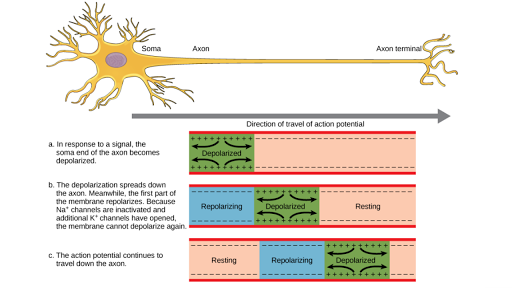
Depolarization Hyperpolarization Neuron Action Potentials Article Khan Academy
Fast EPSPs involve the opening of small cation channels for K and Na Because there is a larger influx of Na compared to K a net depolarization results.
. Describe the changes that occur to the membrane that result in the action potential. The depolarization is an excitatory postsynaptic potential EPSP and may be either fast or slow. If the summation of signals in this region of the neuron depolarizes the cell beyond a threshold potential.
If however the binding decreases the voltage hyperpolarizes the membrane it is inhibitory. A neuron receives input from other neurons and if this input is strong enough the neuron will send the signal to downstream neurons. LTD occurs in many areas of the CNS with varying mechanisms depending upon brain region and developmental progress.
Of its original magnitude and can be calculated by the following equation. Golgi type I neuron and Golgi type II neuron. The cells inside is more negative than the outside d.
Muscle contraction takes place when muscle fibres become shorter. The following events characterize the transmission of a nerve impulse see Figure 1. Based on the length of the axons multipolar neurons are also classified into two types.
Key Takeaways Key Points. We now consider the disturbances in membrane potential that occur when a neuron is stimulated. Outline the steps of the process of communication among neurons.
We consider the process in that order. The neurons or excitable nerve cells of the nervous system conduct electrical impulses or signals that serve as. Action potentials occur in several types of animal cells called excitable cells.
Describe the changes that occur to the membrane that result in the action potential. Transmission of a signal within a neuron from dendrite to axon terminal is carried by a brief reversal of the resting membrane potential called. To understand how neurons are able to communicate it is necessary to describe the role of an excitable membrane in generating these signals.
Whether the voltage is increased or decreased the change. A measure of how fast a stimulus decays at the point of initiation is the time constant τ. Typically but with exceptions the response of a neuron begins at a den-drite spreads through the soma travels down the axon and ends at the synaptic knobs.
Fire a much more intense action potential with a peak of 100 mV. Neural impulses occur when a stimulus depolarizes a cell membrane prompting an action potential which sends an all or nothing signal. As a consequence normally silent NMDA glutamate receptors located in the postsynaptic neuron.
As the opposing process to long-term potentiation LTP LTD is one of several. Neurons can be stimulated by chemicals light heat or mechanical. The longer the time constant the longer the stimulus will remain at the point of initiation leading.
Thus the membrane potential. The multipolar neuron has one axon and multiple dendrites. Multipolar neurons are the most numerous such as the motor neurons in cornu anterius medullae spinalis the pyramidal cells in the cerebral cortex and so on.
The functions of the nervous systemsensation integration and responsedepend on the functions of the neurons underlying these pathways. Transmission of a signal between neurons is generally carried by a chemical called a neurotransmitter. Return to resting membrane potential without generating an action potential.
What happens when a resting neurons membrane depolarizes. The neurons membrane voltage becomes more positive c. The globular heads occur at regular intervals along the myosin myofilament protruding from the filaments sides.
A graded potential is a change in the resting potential of the plasma membrane in the response to a stimulus. In neurophysiology long-term depression LTD is an activity-dependent reduction in the efficacy of neuronal synapses lasting hours or longer following a long patterned stimulus. The neuron is less likely to generate an action potential b.
λ r m r a. The resting potential describes the unstimulated polarized state of a neuron at about 70 millivolts. The functions of the nervous systemsensation integration and responsedepend on the functions of the neurons underlying these pathways.
To understand how neurons are able to communicate it is necessary to describe the role of an excitable membrane in generating these signals. If the binding increases the voltage depolarizes the membrane the synapse is excitatory. An excitatory synapse causes a graded potential that depolarizes the membrane and brings it closer to threshold.
You would expect a neuron that depolarizes to -75 mV would. Where actin and myosin filaments overlap the myosin head might connect to the adjacent actin filament. There is a net diffusion of Na out of the cell e.
When action potentials reach the axon terminal calcium floods the neuron allowing synaptic vesicles to fuse with the membrane and release stored neurotransmitters to target cells. The axon terminal also known as the synaptic bouton and terminal bouton is the most distal portion of a neurons axon and is critical for neural communication. The equilibrium potential for K becomes more positive.
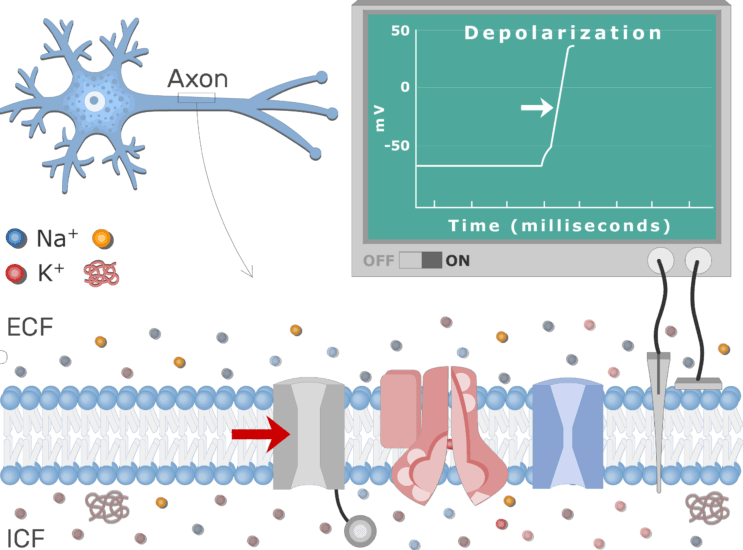
Neuron Action Potential Sequence Of Events
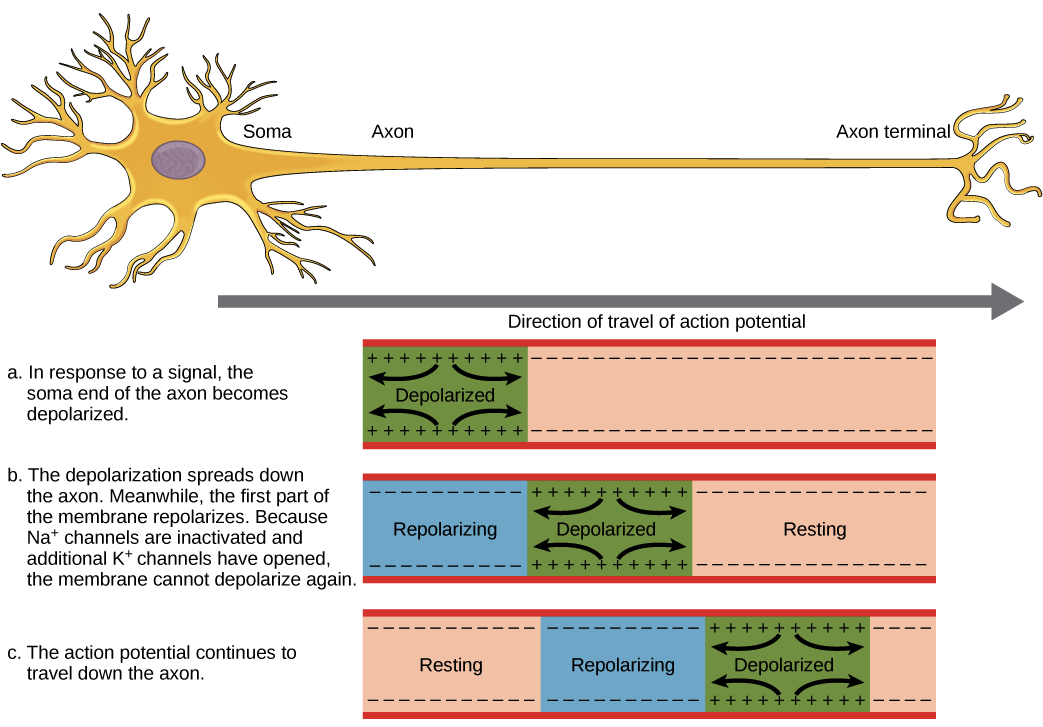
Depolarization Hyperpolarization Neuron Action Potentials Article Khan Academy

Q What Happens In The Depolarization Of A Nerve Studentrdh Blog

Comments
Post a Comment